
The complete guide
- Free standard delivery on orders of $100 or more
- Robotics, science and maker kits
- Delivery in 5 to 7 days after processing
- Customer support 7 days a week
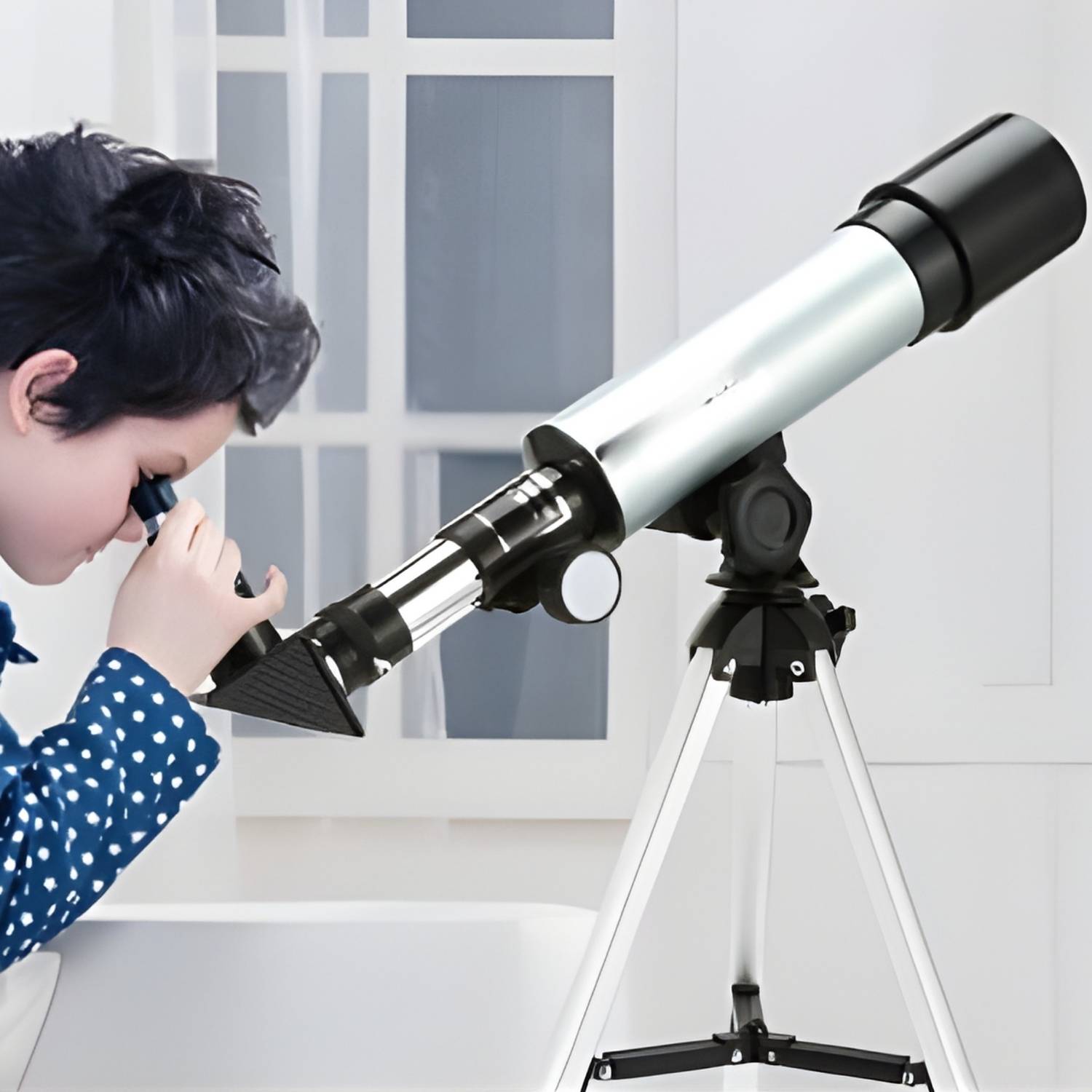
Children's Telescope | Lunar Telescope for Kids | Beginner Telescope
Children's Telescope
$129
- 18x and 90x eyepieces
- 50 mm objective lens
- Quick setup
- Portable
Price: $129
- Handling: 24 to 48 hours. Delivery: 5 to 7 days.
- Free delivery across Singapore on orders $100+, otherwise a flat $25
- Pay by card or PayPal, handled by the payment provider
- Change-of-mind returns within 15 days of purchase require original packaging and proof of purchase. A $39 deduction applies per order; original delivery charges are excluded and return postage is paid by the buyer. Eligible cancellations carry a 12.5% processing fee. This does not limit rights that cannot be excluded under applicable law. Full returns policy
Explore other kits
Product specifications
| Objective lens | 50 mm |
|---|---|
| Eyepieces | 18x and 90x |
| Type | Refracting, beginner astronomical |
| Setup | Tool-free, portable |
Shipping & returns
Standard delivery is S$25, or free from S$100 after discounts. Express Delivery is S$25. Allow 24 to 48 hours for processing and 5 to 7 days for delivery; no separate express arrival date is guaranteed.
Change-of-mind returns within 15 days of purchase require original packaging and proof of purchase. A $39 deduction applies per order; original delivery charges are excluded and return postage is paid by the buyer. Eligible cancellations carry a 12.5% processing fee. This does not limit rights that cannot be excluded under applicable law.
Refunds are processed within 24 to 48 hours after receipt of the returned item, subject to the return assessment; payment-provider processing can take longer.
If it arrives faulty, damaged or not as described, we put it right at no cost to you under the consumer guarantees in the applicable consumer protection law, return postage included.
18x and 90x eyepiecesTwo magnifications in the box
50 mm objective lensEnough aperture for the moon
Quick setupAssembled without tools
PortableCarried out and set up by one child
About this product
A beginner's refracting telescope that shows lunar craters on the first clear night.
A 50 mm objective lens with 18x and 90x eyepieces, set up in minutes and light enough for a child to carry outside.
A beginner's refracting telescope that shows lunar craters on the first clear night.
A 50 mm objective lens with 18x and 90x eyepieces, set up in minutes and light enough for a child to carry outside.
Objective lens: 50 mm.
Eyepieces: 18x and 90x.
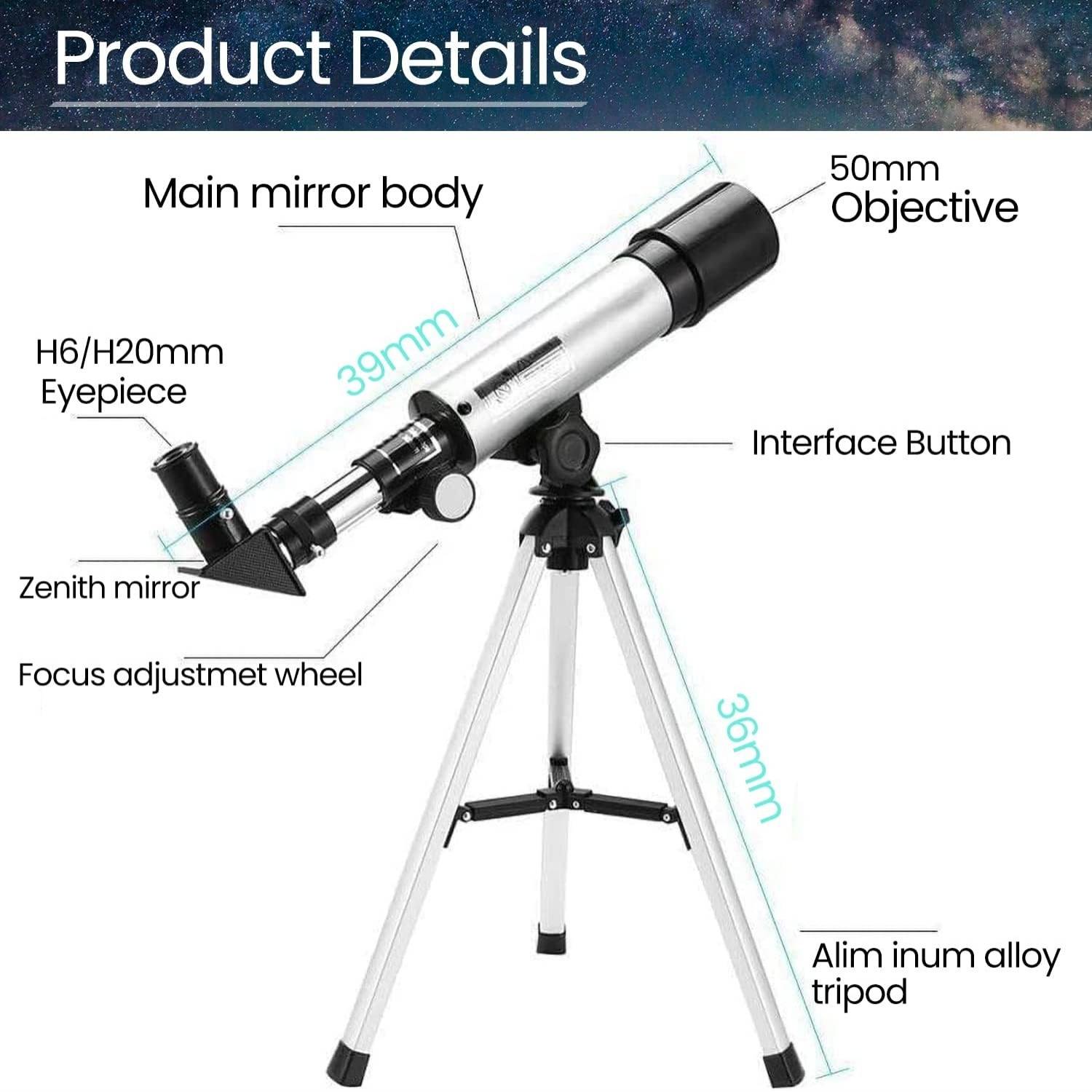
A beginner's refracting telescope that shows lunar craters on the first clear night. A 50 mm objective lens with 18x and 90x eyepieces, set up in minutes and light enough for a child to carry outside.
It is delivered right across Singapore. Delivery is free on orders over $100 and otherwise $25.
Still deciding?
Not sure yet? That is fine.
Change-of-mind returns within 15 days of purchase require original packaging and proof of purchase. A $39 deduction applies per order; original delivery charges are excluded and return postage is paid by the buyer. Eligible cancellations carry a 12.5% processing fee. This does not limit rights that cannot be excluded under applicable law.
For faulty, damaged or misdescribed goods, contact us about your rights under the applicable consumer protection law. The available remedy depends on the problem. Read the returns policy.
Got questions?
Frequently Asked Questions
What can my child actually see with this telescope?
The moon in real detail, including craters, is the reliable one on any clear night. Brighter planets and star clusters are within reach on a good night away from streetlights. It is a 50 mm beginner refractor, so treat photographs of galaxies as a different class of instrument.
How big is the lens?
The objective lens is 50 mm across, with a 360 mm focal length.
What magnifications does it give?
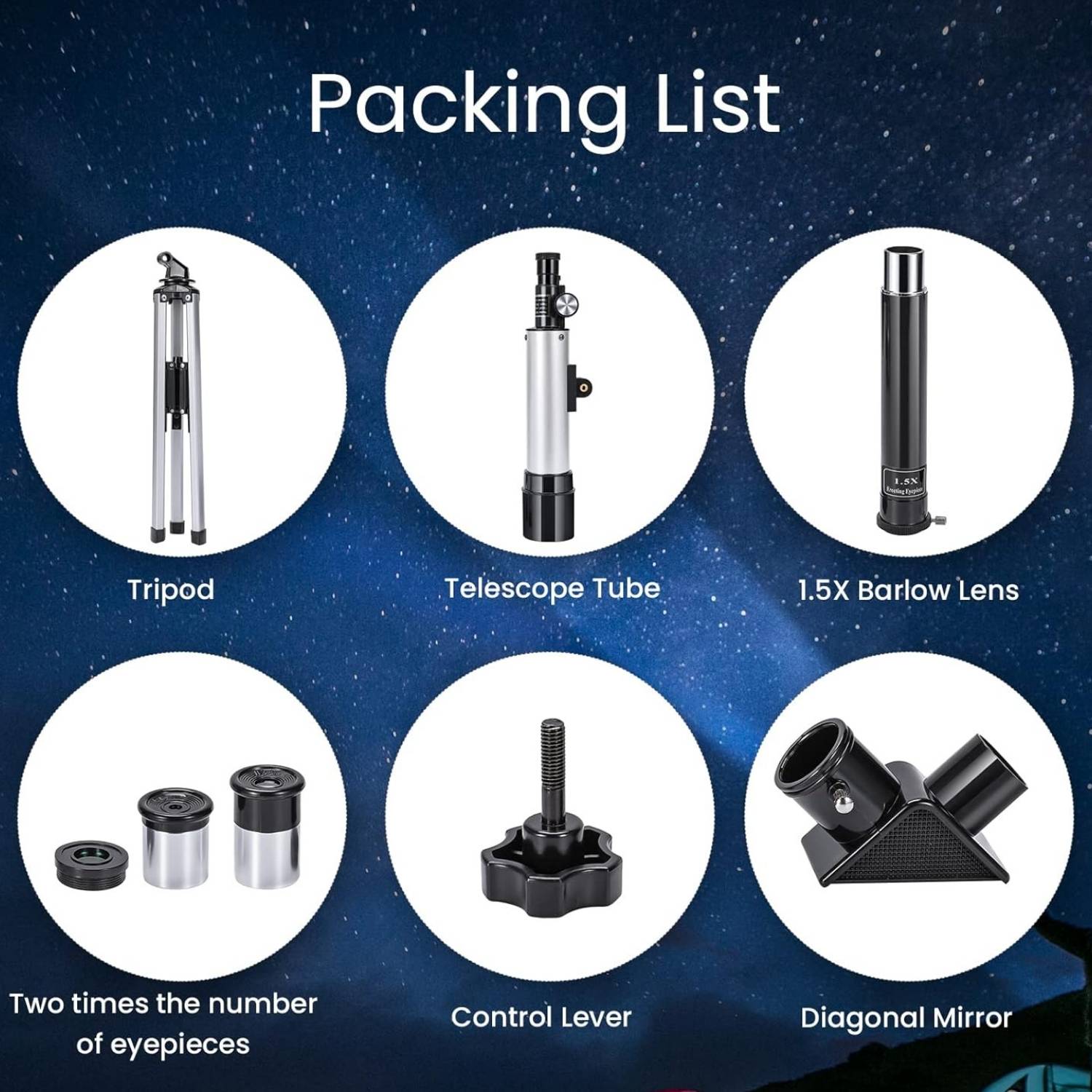
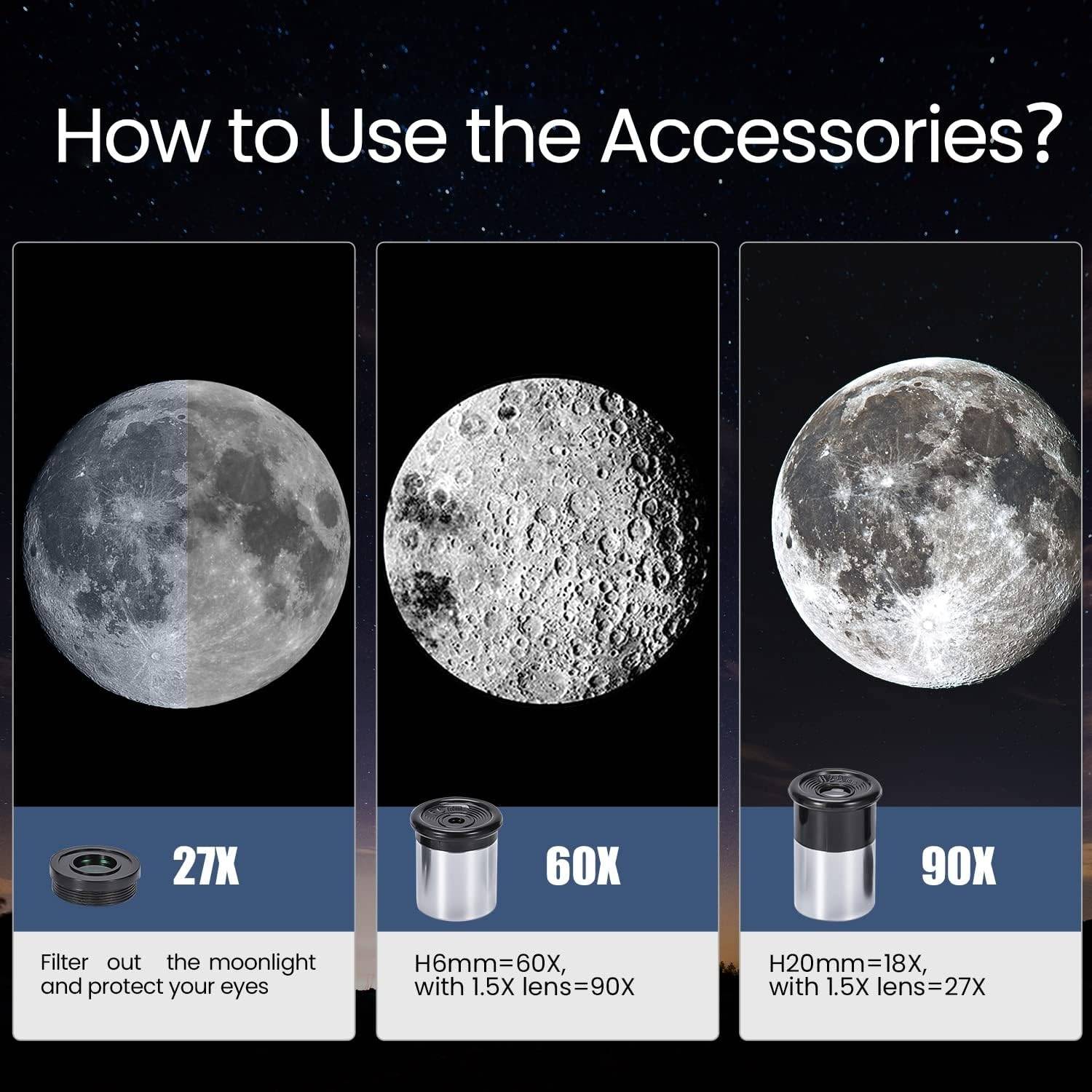
The two eyepieces give 18x and 90x. With the included 1.5x Barlow lens the listing also names 27x and 60x, so four combinations in practice.
Is more magnification always better?
No, and this is the single most useful thing to know before your first night. Aperture, the width of the lens, sets how much detail is there to see. Pushing magnification past what the aperture supports gives you a bigger, dimmer, blurrier picture of the same thing.
What is a Barlow lens?
A short lens that sits between the eyepiece and the telescope and multiplies whatever the eyepiece gives you. This one is 1.5x, so it turns 18x into 27x and 60x into 90x.
How long does it take to set up?
The listing says under a minute, with no tools, following the printed manual. Installation video support is available if you would rather watch it done.
Do I need any tools?
No. It assembles by hand.
How far does it move?
160 degrees vertically and a full 360 degrees horizontally on the tripod.
What is the tripod made of?
Aluminium, and it adjusts for height so a child can use it standing or seated.
Can we take it away with us?
Yes. The telescope and the tripod both pack into the carrying bag that comes with it.
What age is it for?
It is sold as a beginner's telescope for children rather than against a specific age. The setup is simple enough for a first-time user, and the useful test is whether a child can be patient at an eyepiece for a few minutes.
Does an adult need to help?
For the first session, usually yes, mostly with finding a target rather than with the equipment. After that most children run it themselves.
Why does everything look blurry?
Almost always focus. Start on the moon at the lowest magnification, turn the focuser slowly past the sharp point and back to it, and only then change eyepieces. Heat rising off a roof or a driveway also softens the image, so aim over grass where you can.
Why does the image shake?
A tripod on soft ground, a hand still touching the tube, or wind. Let go after you nudge it and give it two or three seconds to settle before you look.
Why can I not find anything?
Align the finder in daylight on a distant fixed object such as a chimney, so that what the finder centres is what the eyepiece shows. Doing that once in the afternoon saves the whole first night.
Is the image upside down?
An astronomical telescope inverts the view. That is normal and it does not matter for the moon or the planets.
Can we look at the sun with it?
No. Never point any telescope at the sun without a proper solar filter fitted at the front. Looking at the sun through an eyepiece causes permanent eye damage in an instant, and no filter is supplied with this telescope.
Can I take photographs through it?
You can hold a phone to the eyepiece and get a recognisable moon. The listing does not include a phone adapter, so expect to steady it by hand.
What are coated optics?
Thin layers on the glass that cut reflections so more light reaches your eye. The listing describes this telescope's glass as fully multi-coated.
Where should we set it up?
As far from house and street lights as you can manage, on firm ground, with a clear view of the part of the sky you want. A back garden is fine for the moon.
Do we need to let it cool down first?
It helps. Take it outside ten or fifteen minutes before you start so the air inside the tube matches the air outside, which steadies the view.
How do we clean the lenses?
As little as possible. Blow dust off first, and only then use a proper lens cloth or lens tissue. Never use a shirt, kitchen towel or household glass cleaner on coated optics.
How should we store it?
In the carrying bag, indoors, with the caps on. A shed or a car boot puts it through temperature swings and damp, which is what fogs and marks optics over time.
What is the resolution figure in the specifications?
The listing quotes a theoretical resolution of 2000 arcseconds. It is a specification of the optics rather than something you will measure in the garden.
Is this a toy?
No. It has real glass optics and a metal tripod, which is the difference between seeing lunar craters and seeing a bright smudge. It is a beginner instrument, not a professional one.
What if a part is missing from the box?
Tell us and we will send it. Do not buy a replacement part before talking to us.
How much does delivery cost?
Delivery is free across Singapore on orders over $100. Below that it is a flat $25.
How long will it take to arrive?
Five to seven days, delivered anywhere in Singapore.
Can I return it if we do not get on with it?
Our refunds and returns policy sets out the conditions and the window. Read it before you order so there are no surprises, and ask us if anything in it is unclear.
What currency are the prices in?
US dollars. The price you see is the price you pay, and delivery is added at checkout unless your order qualifies for free delivery.
It offers wide and close-up views of the Moon, revealing intricate details of craters, volcanoes, and more.
Compact and affordable, this beginner-friendly telescope is designed to unlock a world of discovery.
EACH KIT INCLUDES
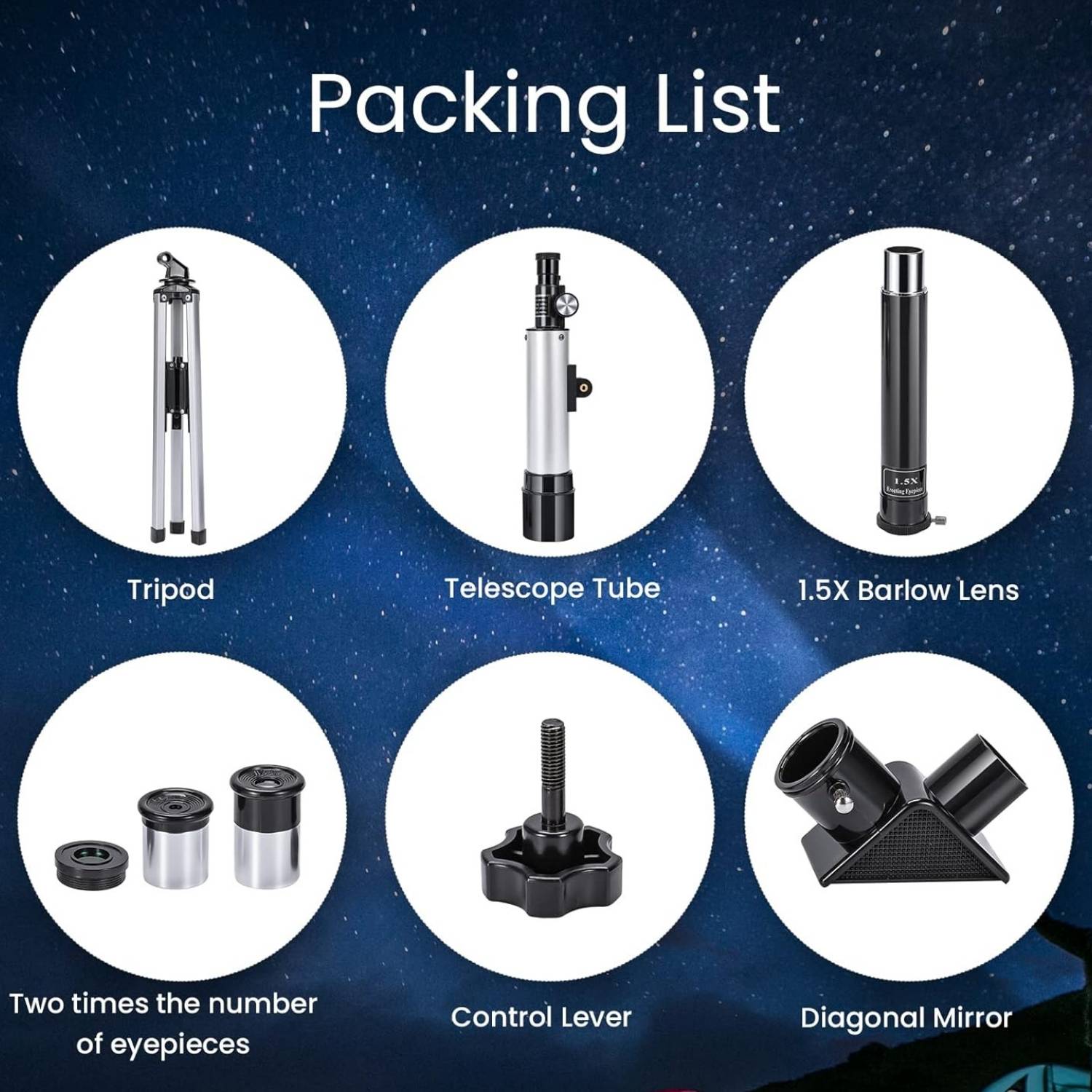
SPECIFICATIONS
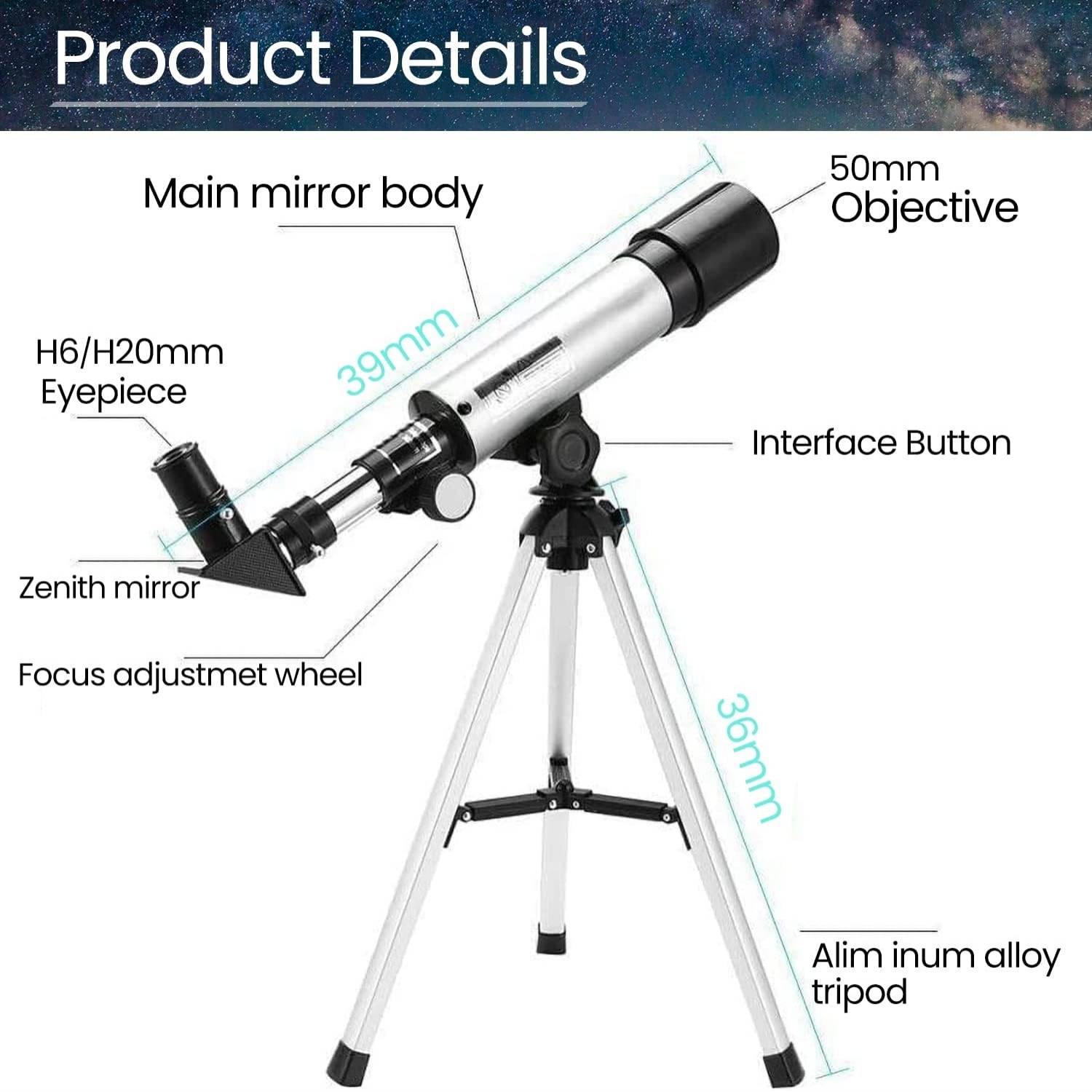
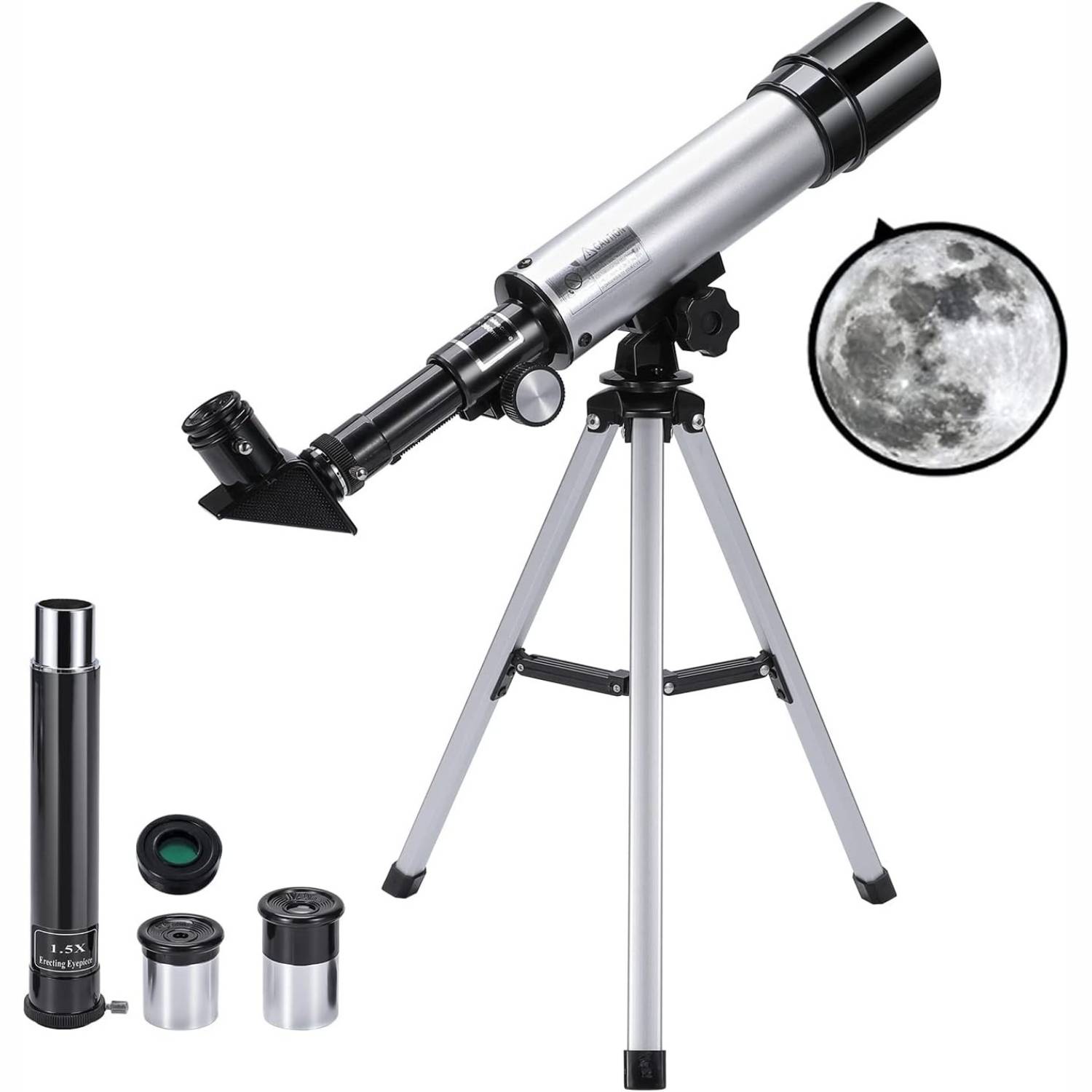
- 18x and 90x magnification eyepieces
- 360mm focal length
- 50mm objective lens diameter
- 3.2cm optical system

PLEASE ALLOW 5-7 DAYS SHIPPING
Direct To Your Door - All Across The USA

Multiple Magnification Options for Versatile Viewing
Choose from five different magnification combinations: 18x, 27x, 60x, and 90x power levels by combining the included eyepieces with the 1.5x Barlow lens. Switch between settings to explore nearby objects or distant celestial targets. This flexibility helps young astronomers quickly find and focus on subjects at varying distances with crystal-clear detail.Premium Optical Performance
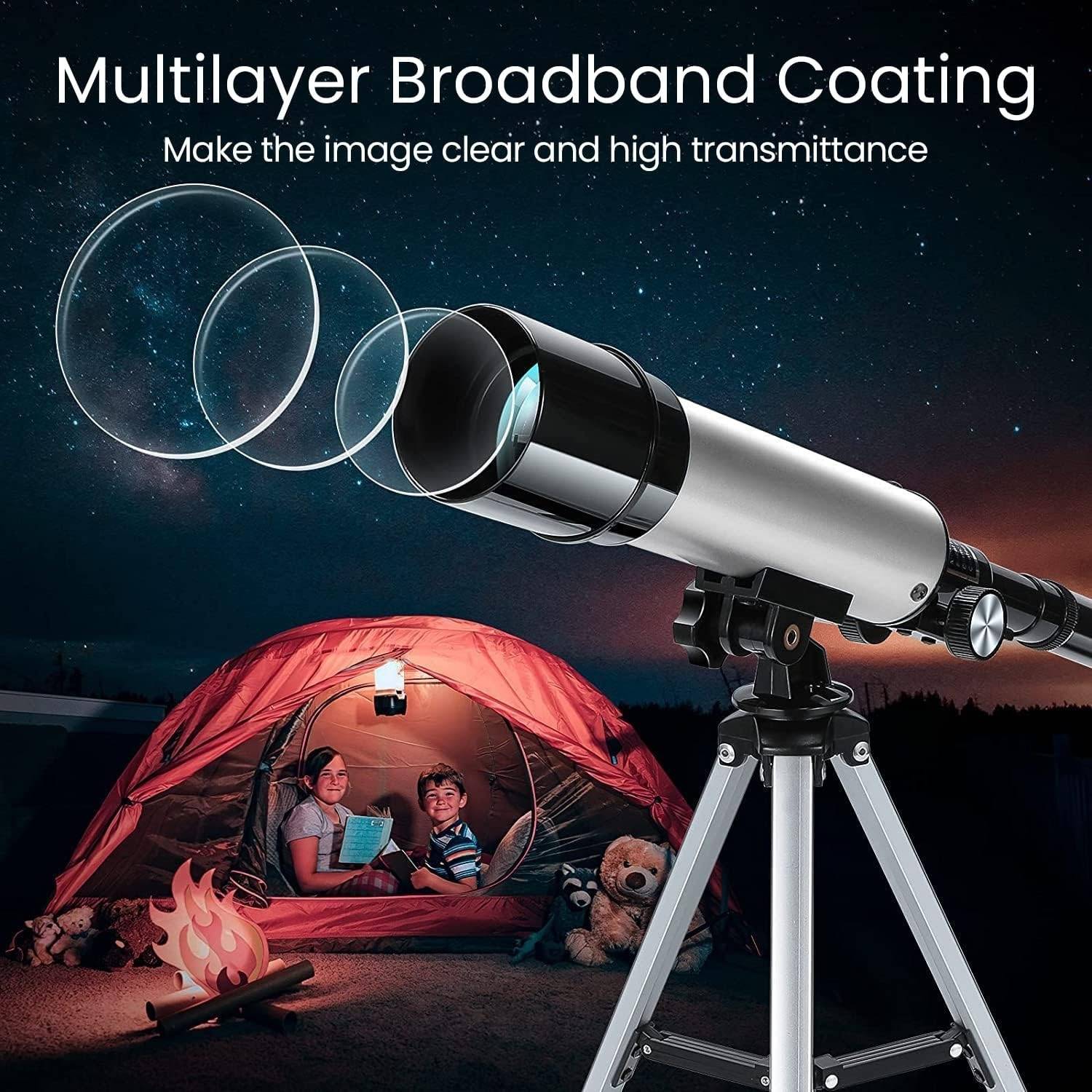
Featuring a 50mm aperture with 360mm focal length, this refractor telescope achieves 90x maximum magnification and 2000 arcsecond theoretical resolution. Fully multi-coated optical glass lenses maximize light transmission for exceptional brightness and image clarity. The quality optics protect developing eyes while delivering professional-grade views of the night sky.Quick Setup Without Tools
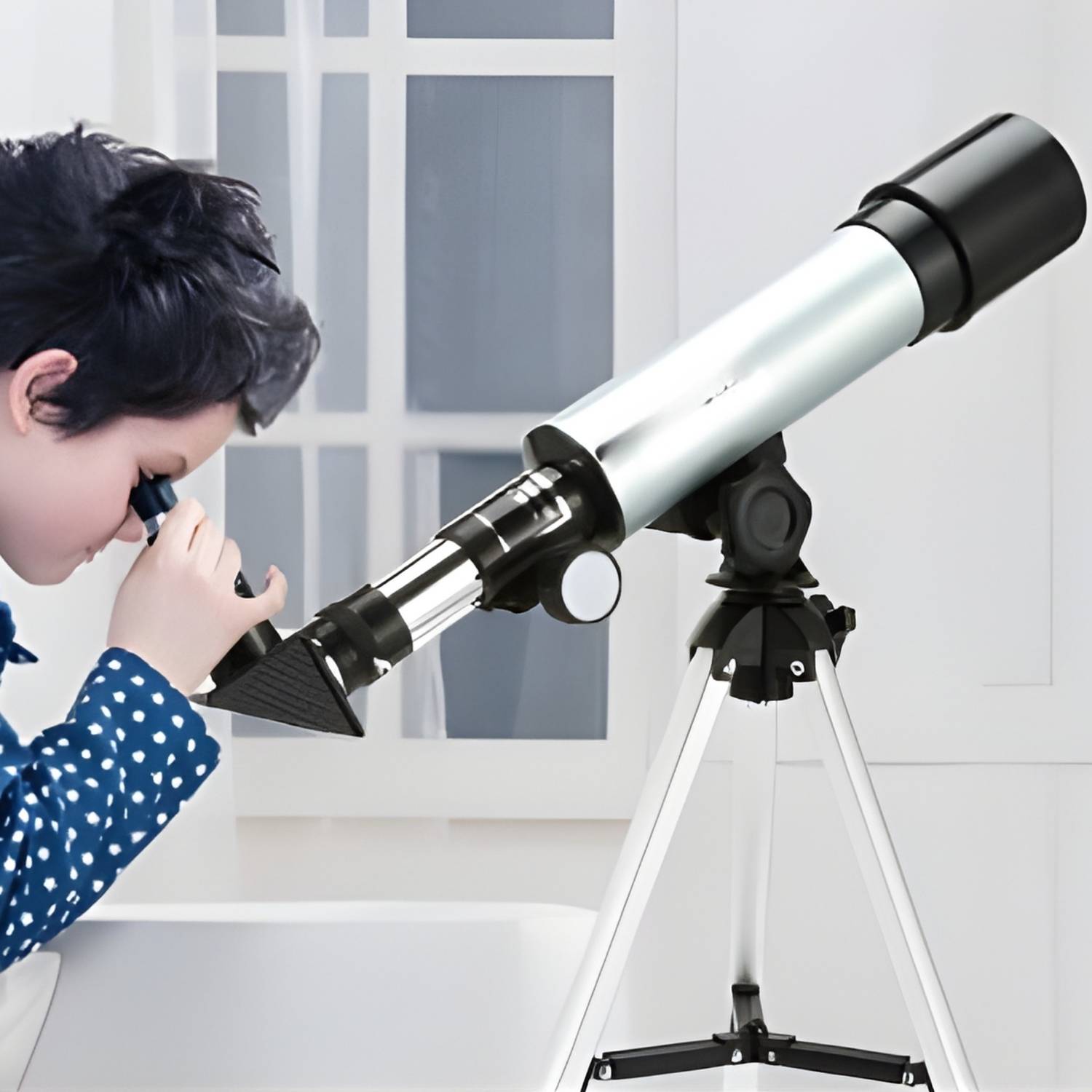
Assembly takes less than one minute using the included instruction manual, with no tools required. The telescope adjusts 160 degrees vertically and rotates 360 degrees horizontally for complete sky coverage. Even first-time users can set up confidently, and installation video support is available for additional guidance.Portable Aluminum Tripod System
The adjustable aluminum tripod provides stable viewing from multiple heights and angles. Both telescope and tripod pack conveniently into the included carrying bag for transport to dark sky locations or travel adventures. Perfect for parents and children to explore astronomy together while nurturing curiosity about space and the universe.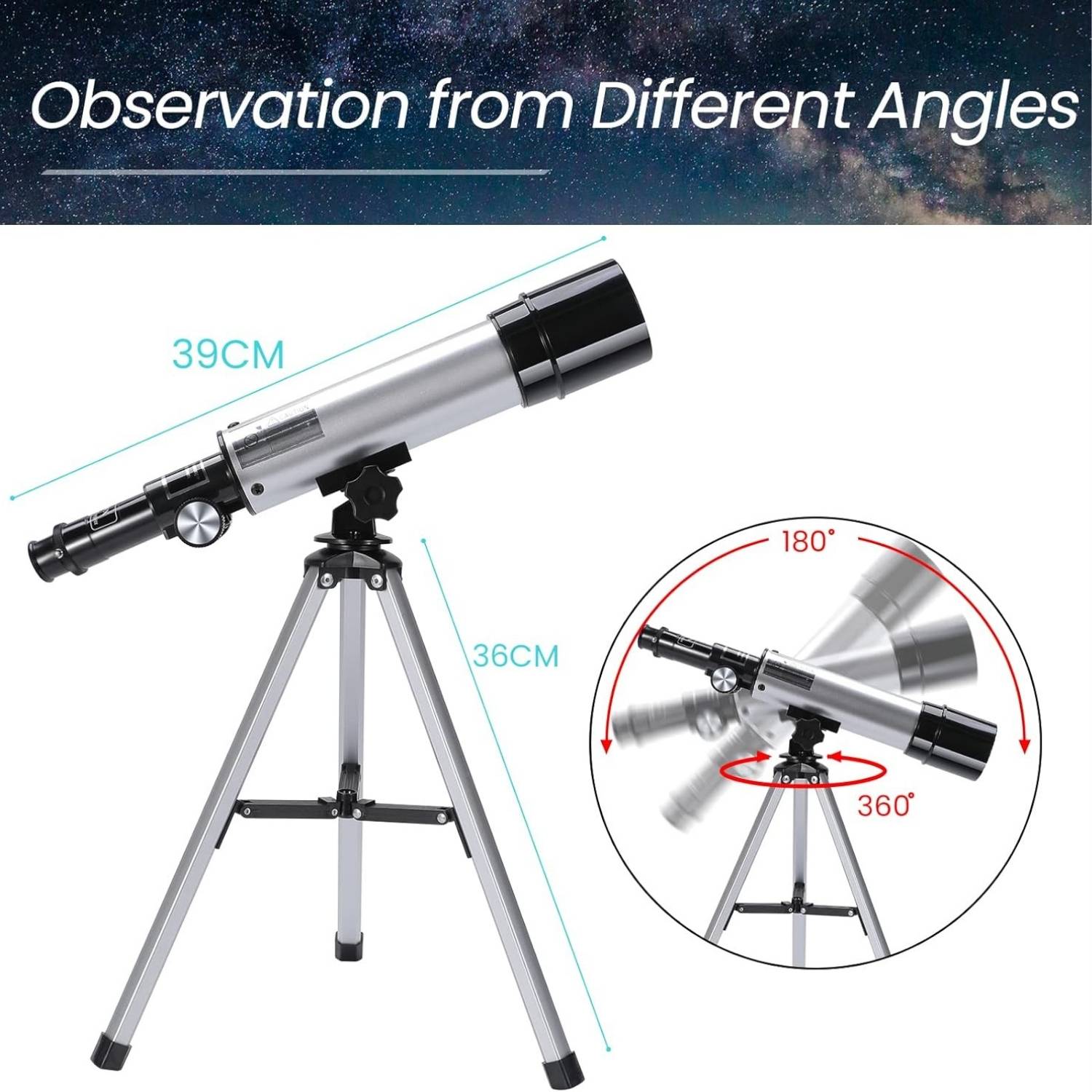

 Frequently Asked Questions

Kids Telescope: Your Complete Guide to Inspiring the Next Generation of Astronomers
Have you ever watched your child's face light up when they spot the moon in the evening sky, asking endless questions about stars, planets, and what lies beyond our world? That natural curiosity about the cosmos represents one of childhood's most precious gifts, yet so many parents struggle to nurture it effectively. A quality kids telescope transforms abstract wonder into tangible discovery, converting those questions into hands-on exploration that builds genuine understanding and lasting fascination with science.
The challenge most parents face isn't whether their children would enjoy astronomy. It's finding equipment that actually works without requiring an advanced degree to operate. Too many astronomical telescopes marketed for children deliver frustrating experiences with blurry images, impossible setup procedures, and construction so flimsy the telescope becomes unusable after a few sessions. These disappointments don't just waste money. They extinguish that spark of curiosity that drew your child to the stars in the first place.In this comprehensive guide, we're exploring everything you need to know about choosing and using a space telescope for kids. From understanding what specifications actually matter to mastering the techniques that deliver successful stargazing sessions, you'll discover how to transform your backyard into a gateway to the universe. Whether your child dreams of becoming an astronaut, simply loves the night sky, or needs an engaging alternative to screen time, the right astronomical telescope for children opens worlds of discovery. Let's explore what separates magical experiences from expensive disappointments.
Understanding Kids Telescopes: More Than Just Toys
Before diving into specific features and models, let's establish what makes a proper kids telescope different from both toy versions and professional equipment.What Defines a Quality Space Telescope for Kids
A genuine astronomical telescope for children isn't a toy with plastic lenses that magnifies nothing clearly. Neither is it professional equipment requiring extensive knowledge to operate effectively. Quality kids telescopes occupy the critical middle ground where real optical performance meets user-friendly design.These telescopes incorporate actual glass optics capable of revealing genuine celestial detail. You'll observe lunar craters, see Saturn's rings, identify Jupiter's largest moons, and resolve details invisible to the naked eye. The images might not match what professional observatories produce, but they're authentic views of actual celestial objects rather than blurry approximations.
Equally important, these telescopes acknowledge their users' experience level. Setup procedures stay straightforward without requiring alignment procedures that frustrate even adults. Controls remain intuitive rather than requiring constant reference to instruction manuals. The construction balances durability with portability, recognizing these telescopes will be moved frequently and handled by enthusiastic young astronomers.
The Science Behind Seeing Stars
Understanding basic telescope operation helps you appreciate what your kids telescope can and cannot show. Telescopes perform two primary functions: they collect light and they magnify images.Light collection depends on aperture, the diameter of the main lens or mirror. Larger apertures gather more light, revealing fainter objects and showing more detail on bright ones. A 50mm aperture telescope gathers significantly more light than the human eye's 7mm pupil, making objects appear much brighter and clearer.
Magnification makes objects appear larger but doesn't necessarily show more detail. Empty magnification, magnifying without corresponding increases in resolution, produces larger but fuzzier images. Quality astronomical telescopes for children balance magnification with aperture to deliver clear, detailed views rather than impressively high but useless magnification numbers.
Refractor telescopes, the type most common for beginners, use lenses to collect and focus light. These designs deliver sharp, high-contrast images perfect for observing the Moon, planets, and bright deep-sky objects. They require minimal maintenance and stay aligned permanently once assembled, making them ideal for space telescopes for kids.
Essential Specifications That Actually Matter
Telescope specifications can overwhelm parents unfamiliar with astronomy. Let's translate the numbers into practical capabilities you can understand.Aperture: The Most Important Number
Aperture, measured in millimeters, indicates the diameter of the telescope's main lens. For kids telescopes, apertures typically range from 40mm to 70mm. This specification matters more than any other because it determines how much light the telescope collects.A 50mm aperture provides excellent performance for lunar observation, planetary viewing, and bright star clusters. You'll see lunar craters clearly, observe cloud bands on Jupiter, and resolve Saturn's rings distinctly. Smaller apertures around 40mm still perform adequately for the Moon and bright planets, while larger 60-70mm apertures reveal fainter objects and show more planetary detail.
Don't be seduced by magnification claims without considering aperture. A telescope advertising 200x magnification with only a 40mm aperture delivers blurry, dim images at high powers. Aperture sets the fundamental limit on useful magnification, roughly twice the aperture in millimeters. A 50mm telescope performs well up to about 100x magnification.
Focal Length and Magnification
Focal length, also measured in millimeters, indicates the distance light travels inside the telescope before coming to focus. For astronomical telescopes for children, focal lengths typically range from 300mm to 600mm. Longer focal lengths produce higher magnifications with the same eyepiece.Magnification results from dividing focal length by eyepiece focal length. A 360mm focal length telescope with an 18mm eyepiece produces 20x magnification (360 ÷ 18 = 20). The same telescope with a 6mm eyepiece delivers 60x magnification (360 ÷ 6 = 60).
Quality kids telescopes include multiple eyepieces providing different magnification options. Lower powers deliver wider views perfect for scanning the Moon's full disk or locating objects in the sky. Higher powers show finer details on planets or specific lunar features. Having both options maximizes versatility.
Optical Quality and Coatings
Glass quality and lens coatings profoundly affect image quality even when aperture and focal length match between telescopes. Quality space telescopes for kids use fully coated optics, meaning anti-reflection coatings cover all air-to-glass surfaces.These coatings reduce light loss from reflection and minimize internal reflections that degrade contrast. Uncoated optics might lose 50% of incoming light to reflections, producing dim, low-contrast images. Fully coated optics typically transmit 90% or more of light, delivering bright, sharp views.
The difference becomes immediately apparent when observing. Coated optics show lunar details with crisp definition and high contrast. Planetary features appear distinct rather than washed out. Even relatively small aperture telescopes with quality coatings outperform larger aperture telescopes with poor optics.
Features That Enhance the Stargazing Experience
Beyond core optical specifications, certain features dramatically improve usability for young astronomers learning to explore the night sky.Tripod Stability and Adjustability
The tripod supporting your astronomical telescope for children matters as much as the telescope itself. Shaky, wobbly tripods make focusing impossible and turn every attempt to center objects into frustrating struggles.Quality tripods use aluminum construction rather than thin plastic. They extend to heights allowing comfortable viewing without excessive stooping, yet collapse compactly for storage and transport. Adjustable legs accommodate uneven ground, ensuring stable setup regardless of terrain.
The mount connecting telescope to tripod should allow smooth motion both vertically and horizontally. Stiff mounts make tracking celestial objects difficult, while overly loose mounts allow the telescope to drift when you release it. Quality mounts balance these extremes, moving easily when adjusted but holding position firmly when released.
Eyepiece Selection and Barlow Lenses
Multiple eyepieces transform a single kids telescope into a versatile observing instrument. A typical beginner set includes two or three eyepieces providing low, medium, and high magnification options.Low power eyepieces (typically 18-20mm focal length) deliver wide views perfect for scanning the Moon, locating planets, or observing large star clusters. These lower magnifications show brighter images and wider fields, making objects easier to find and keep centered.
High power eyepieces (typically 4-6mm focal length) magnify small details on planets or specific lunar features. While showing smaller areas of sky, these eyepieces reveal finer details when atmospheric conditions cooperate.
Barlow lenses multiply magnification by inserting between eyepiece and telescope. A 1.5x Barlow converts an 18mm eyepiece into effective 12mm magnification (18 ÷ 1.5 = 12), while a 3x Barlow creates 6mm equivalent magnification. This multiplies your eyepiece collection's versatility without buying additional eyepieces.
Finderscopes and Alignment Tools
Finding celestial objects through a telescope's narrow field of view challenges even experienced astronomers. Finderscopes, small low-power telescopes mounted atop the main telescope, make locating objects dramatically easier.These finders show much wider sky areas than the main telescope, making it simple to point at your target. Once centered in the finder, objects appear in the main telescope's field. Without a finder, you're essentially pointing a narrow tube at the sky hoping to randomly encounter your target.
Some space telescopes for kids use red dot finders instead of traditional finderscopes. These project a red dot onto a clear window, allowing you to point at objects with both eyes open. While less precise than optical finders, red dot finders work well for the Moon, bright planets, and large star clusters.
What You Can Actually Observe With Kids Telescopes
Understanding realistic expectations prevents disappointment and helps you maximize successful observations with your astronomical telescope for children.The Moon: Your First and Best Target
The Moon represents the perfect first target for any kids telescope. It's large, bright, easy to find, and reveals stunning detail even through small apertures. Craters, mountain ranges, valleys, and maria (dark plains) appear with remarkable clarity.The best lunar observing occurs along the terminator, the line separating day and night on the Moon's surface. Here, low sun angles create dramatic shadows highlighting three-dimensional terrain features. Full moon appears bright and impressive but shows less detail because overhead sunlight eliminates shadows.
Different magnifications reveal different lunar aspects. Low powers show the entire disk, perfect for appreciating the Moon's overall appearance and major features. High powers zoom into specific craters or mountain ranges, revealing intricate details of individual formations.
Planets: The Solar System in Your Backyard
Quality astronomical telescopes for children reveal genuine planetary details that bring solar system textbook illustrations to life. Saturn's rings appear distinct and beautiful, one of astronomy's most rewarding sights. Jupiter shows cloud bands across its disk plus four bright moons orbiting like a miniature solar system.Mars reveals its distinctive red color and, during favorable oppositions when it approaches Earth closely, hints of darker surface features. Venus displays phases like a miniature moon, waxing and waning as it orbits between Earth and Sun.
Mercury occasionally appears during evening or morning twilight, while Uranus and Neptune technically lie within reach of 50mm telescopes but appear only as tiny colored dots. Setting realistic expectations about planetary detail prevents disappointment while appreciating what small telescopes genuinely reveal builds lasting enthusiasm.
Stars, Clusters, and Beyond
Individual stars don't appear larger through telescopes because their immense distances render them essentially point sources of light. However, telescopes reveal thousands of stars invisible to naked eyes, transforming familiar constellations into dense star fields.Star clusters provide spectacular views through kids telescopes. The Pleiades star cluster showcases dozens of bright stars nestled together, while double stars reveal their true nature as two stars orbiting each other. Some doubles show contrasting colors, one star appearing orange while its companion shines blue-white.
Galaxies and nebulae remain challenging for small aperture telescopes, though the brightest examples like the Orion Nebula or Andromeda Galaxy show as faint fuzzy patches. These observations plant seeds of curiosity that deeper exploration can satisfy as interest and equipment evolve.
Setting Up Your Space Telescope for Kids Successfully
Proper setup determines whether your first observing sessions deliver wonder or frustration. Following proven procedures ensures success from the beginning.Assembly and Initial Configuration
Quality astronomical telescopes for children assemble quickly without requiring tools. Begin by setting up the tripod, extending legs to appropriate height and ensuring stable placement on level ground. Lock all adjustment knobs firmly to prevent unexpected collapse.Attach the telescope to the tripod mount, securing all connection points. Install the finderscope or red dot finder according to instructions, ensuring it points in the same direction as the main telescope. Insert the lowest power eyepiece to provide the widest field of view.
During daylight, practice finding and centering distant terrestrial objects like tree tops or building features. This familiarizes you with how the telescope moves and focuses before attempting to locate celestial targets in darkness.
Focusing Techniques for Clear Views
Achieving sharp focus makes the difference between disappointing blurs and stunning detail. Start with your lowest power eyepiece and brightest target (the Moon if available, or a bright star otherwise).Turn the focus knob slowly while watching the image carefully. The object will transition from very blurry to slightly less blurry to sharp to blurry again as you pass through focus. When you've gone too far, reverse direction and approach focus from the other side.
Perfect focus produces the sharpest, most detailed image possible. Lunar craters show crisp edges, planetary disks appear distinct, and stars focus to tiny points rather than fuzzy blobs. Atmospheric turbulence causes images to shimmer and dance even when perfectly focused, this is normal and unavoidable.
Finder Alignment Procedures
Aligning your finderscope or red dot finder during daylight saves enormous frustration during nighttime observing. Point your kids telescope at a distant, distinct object like a building corner or isolated tree.Center the object perfectly in your main telescope's eyepiece. Now look through the finder. The same object should be centered in the finder. If it isn't, adjust the finder's alignment screws until the finder and main telescope show identical views.
Once aligned, the finder stays aligned until the telescope experiences rough handling. This alignment means anything centered in your finder automatically appears in the main telescope, making target location effortless.
Maximizing Success During Observing Sessions
Successful astronomy sessions require more than quality equipment. Following proven practices ensures rewarding experiences that build enthusiasm rather than frustration.Choosing Optimal Observing Conditions
Not all nights offer equal observing conditions. Clear, moonless nights far from city lights provide ideal circumstances, but you don't need perfection to enjoy your astronomical telescope for children.The Moon remains easily visible even from light-polluted urban locations. Bright planets likewise shine through considerable light pollution. On these targets, convenience matters more than pristine darkness, so backyard observing works perfectly well.
For stars, clusters, and other faint objects, darkness matters more. Even traveling just outside town to darker locations dramatically improves what you can see. Allow 20-30 minutes for your eyes to adapt to darkness, during which faint objects progressively become more visible.
Tracking Celestial Objects
Earth's rotation makes celestial objects drift across your telescope's field of view, exiting the frame within minutes at high magnification. This isn't a defect in your space telescope for kids. It's simply the result of observing from a rotating planet.Manual tracking involves gently nudging the telescope to keep objects centered. With practice, this becomes automatic and unobtrusive. Start with lower magnifications providing wider fields where objects remain visible longer, building tracking skills before attempting high magnifications.
The Moon moves its own diameter in about two minutes. At low power showing the full disk, you might track for 10-15 minutes before needing adjustment. At high power showing a single crater, recentering becomes necessary every minute or two.
Recording Observations and Building Skills
Keeping an observation log transforms casual stargazing into scientific exploration. Simple notebooks recording dates, times, objects observed, and brief descriptions build valuable records tracking your child's developing skills and knowledge.Sketching what you see strengthens observation skills dramatically. The process of drawing forces careful attention to detail, revealing features casual viewing might miss. These sketches become treasured records of astronomical adventures, tangible evidence of discoveries made.
Photography through kids telescopes remains challenging but achievable. Smartphone adapters allowing phones to photograph through eyepieces make lunar photography accessible for beginners. While results won't match professional astrophotography, successfully capturing recognizable lunar craters or Jupiter's moons provides tremendous satisfaction.
Troubleshooting Common Problems
Even quality astronomical telescopes for children occasionally present challenges. Understanding common issues and their solutions keeps observing sessions on track.Blurry or Unfocused Images
If you cannot achieve sharp focus regardless of focus knob position, several factors might be responsible. Most commonly, the eyepiece sits at the wrong height relative to the telescope. Some telescopes include extension tubes or diagonal prisms that must be inserted or removed to achieve focus.Atmospheric turbulence also affects focus, causing images to shimmer, dance, and appear soft even when the telescope focuses perfectly. This proves especially problematic when observing shortly after sunset when ground heat creates turbulent air. Later observations after the ground cools often show steadier images.
Dirty optics degrade image quality dramatically. Dust on lenses or eyepieces scatters light, reducing contrast and sharpness. Clean optics carefully using appropriate lens cleaning supplies, never household cleaners or rough materials that scratch delicate coatings.
Difficulty Finding Objects
If you struggle to locate celestial targets, first verify your finder remains aligned with the main telescope. Finders get knocked out of alignment easily, making target location nearly impossible.Start with easy targets before attempting challenging ones. The Moon, when visible, provides the perfect starting point. Once you've successfully found, centered, and focused on the Moon, move to bright planets or easy star clusters. Build skills progressively rather than immediately attempting difficult targets.
Use planetarium apps on smartphones to identify what's currently visible and where to look. These apps show real-time sky maps, pointing you toward planets, constellations, and interesting objects worth observing through your kids telescope.
Shaky or Unstable Images
Vibrations make viewing frustrating and detail impossible to resolve. Wind rocks the telescope, nearby foot traffic transmits vibrations through the ground, and even touching the telescope to adjust it causes shaking.Ensure tripod legs lock firmly and stand on solid surfaces rather than soft ground where possible. Let vibrations dampen before observing after adjusting the telescope. On very windy nights, consider rescheduling observations for calmer conditions.
Some vibration simply reflects high magnification amplifying every tiny movement. Lower magnifications show steadier images because they amplify motion less. When conditions prevent steady high-power viewing, enjoy excellent low-power views instead of fighting frustration.
Maintaining Your Astronomical Telescope for Children
Proper care ensures your space telescope for kids delivers years of reliable service, becoming a treasured tool for countless observations.Cleaning and Storage
Store your telescope in its case or covered location protected from dust, moisture, and temperature extremes. Basements and garages work well if they stay dry. Avoid attics where summer heat and winter cold create damaging temperature swings.Clean lenses only when necessary using appropriate lens tissue and cleaning solution designed for optical glass. Never use household glass cleaners, paper towels, or rough materials. Blow away loose dust with compressed air before wiping to avoid grinding particles across delicate surfaces.
Eyepieces deserve particular attention because they're handled frequently and collect dust easily. Keep caps on eyepieces when not in use. Store them in protective cases rather than loose in bags where they can scratch or collect debris.
Transportation and Handling
Quality kids telescopes tolerate reasonable handling but aren't indestructible. Use carrying cases when transporting to observing locations. Pad telescopes in vehicles to prevent impacts and vibrations during travel.Teach young users to handle the telescope gently, avoiding impacts and rough treatment. While construction can tolerate normal use, dropping or striking the telescope can knock optical elements out of alignment or crack lenses.
Check all adjustment knobs periodically to ensure they remain snug but not overtight. Verify the finder stays aligned before observing sessions. Test focus mechanisms to confirm smooth operation without excessive force required.
Growing With Your Telescope
A quality astronomical telescope for children serves not as a temporary toy but as a lasting educational tool growing with your child's developing interest and skills.Advancing Skills and Knowledge
As familiarity grows, challenge your young astronomer with progressively more difficult targets. After mastering the Moon and bright planets, attempt star clusters, double stars, and bright nebulae. Each success builds confidence and expertise.Introduce constellation learning using apps or star charts. Understanding how celestial objects relate to constellation patterns makes navigation and target location progressively easier. This knowledge transforms random star groupings into familiar signposts guiding you across the night sky.
Connect observations to broader scientific understanding. Discuss why Saturn has rings, how craters formed on the Moon, or why planets appear brighter than stars. These connections transform telescope views from pretty sights into windows revealing the universe's underlying principles.
Joining the Astronomy Community
Local astronomy clubs welcome beginners enthusiastically, offering observing sessions, workshops, and mentoring from experienced astronomers. These connections provide guidance, answer questions, and introduce young astronomers to others sharing their passion.Public star parties put quality telescopes in your child's hands, showing what advanced equipment reveals while connecting with the broader astronomy community. These events demonstrate that astronomy isn't solitary but social, shared with enthusiasts worldwide.
Making Your Decision
After exploring every aspect of kids telescopes, how do you decide if investing in an astronomical telescope for children makes sense for your family?These instruments deliver maximum value when your child shows genuine interest in space and astronomy. That interest might be fleeting curiosity or deep fascination, but either deserves nurturing through hands-on exploration. A quality space telescope for kids converts abstract wonder into concrete discovery.
They're particularly valuable for children needing engaging alternatives to screen time. The night sky offers entertainment requiring no batteries, producing no blue light, and rewarding patience with genuine accomplishment. Successfully finding and observing Saturn's rings builds satisfaction no video game matches.
Consider your specific situation. If you live under reasonably dark skies with clear weather, telescopes deliver their full potential. Urban locations with light pollution still permit excellent lunar and planetary observation. Only the most light-polluted environments significantly limit what you can observe.
Conclusion: Opening Windows to the Universe
The night sky has inspired humanity throughout history, sparking questions that drove scientific advancement and philosophical insight. Today, that same sky waits to inspire your child, offering wonders that television and computers cannot match.A quality kids telescope isn't an extravagance or luxury purchase. It's an investment in education, wonder, and the kind of hands-on learning that builds genuine understanding. The telescope doesn't just magnify celestial objects. It magnifies curiosity, nurtures patience, and demonstrates that the universe reveals its secrets to those willing to look carefully.
Whether observing lunar craters carved billions of years ago, watching Jupiter's moons dance through their ancient orbits, or simply scanning the Milky Way revealing thousands of distant suns, your astronomical telescope for children opens doors to experiences that shape perspective and understanding. These aren't virtual experiences or secondhand accounts. They're direct observations of the actual universe, glimpses of reality no screen can truly convey.
The memories created during backyard stargazing sessions last lifetimes. The child who discovers Saturn's rings through their own telescope carries that moment forward, perhaps toward careers in science, or simply toward a deeper appreciation of our place in the cosmos. Either outcome justifies the investment many times over.
Your child's astronomy journey begins with a single observation through a quality space telescope for kids. That first glimpse of a lunar crater or distant planet opens worlds literally and figuratively, transforming the night sky from distant decoration into accessible wonder. Give your child that advantage, and watch as the universe reveals itself one observation at a time.
Page summary
Children's Telescope (SKU kids-telescope-kit) sold by STEM Learning Company at stemlearning.asia, $129 SGD. A beginner's refracting telescope that shows lunar craters on the first clear night. A 50 mm objective lens with 18x and 90x eyepieces, set up in minutes and light enough for a child to carry outside. Delivery is Singapore wide, free on orders of $100 or more and otherwise a flat $25, arriving in 5 to 7 days. Rights that cannot be excluded under applicable law apply. Prices are in Singapore dollars.
$129